
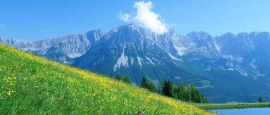



The Arlberg region of Tirol and Vorarlberg is one of Austria's best-known mountain destinations. St Anton am Arlberg, Lech and Zürs provide extensive skiing in winter, while hiking, mountain biking and cable-car routes attract visitors during the warmer months. The linked Ski Arlberg area connects several resorts and forms Austria's largest interconnected ski area.
Book and Go

Latest features
Austria things to see and do
Arlberg
Eisriesenwelt
Located above Werfen in Salzburg province, Eisriesenwelt is the world's largest known ice-cave system, extending for more than 42km (26 miles) through the Tennengebirge mountains. Guided visits explore the accessible section of the caves, where huge natural ice formations remain frozen throughout the year. Reaching the entrance involves a combination of road transport, a steep walk and a cable-car journey, and warm clothing and sturdy footwear are advisable even in summer.
Graz
Austria's second-largest city has a UNESCO-listed historic centre filled with medieval, Renaissance and Baroque architecture. The Schlossberg rises above the old town, crowned by the landmark Uhrturm clock tower, while Eggenberg Palace forms part of the city's World Heritage Site. Graz also has a strong contemporary side, represented by the Kunsthaus and Murinsel, both created when the city was European Capital of Culture in 2003.
Grossglockner High Alpine Road
This spectacular mountain road crosses Hohe Tauern National Park and provides views of glaciers and the 3,798m (12,461ft) Grossglockner, Austria's highest mountain. Numerous viewpoints and walking trails lie along the route. The road is seasonal and normally closes during winter.
Hallstatt and the Salzkammergut
Hallstatt occupies a dramatic position between Hallstätter See and the Dachstein mountains in the Salzkammergut. The surrounding UNESCO-listed cultural landscape has a history of salt mining stretching back thousands of years, while the wider region is dotted with lakes, mountains and traditional towns and villages. Visitors can explore the historic salt mine above Hallstatt or use the town as a base for boat trips, walking and exploring the surrounding lake district.
Hohe Tauern National Park
Austria's largest national park extends across Salzburg, Tirol and Carinthia and protects some of the country's most dramatic Alpine scenery. It encompasses high peaks, glaciers, mountain valleys and waterfalls, including the Grossglockner, Austria's highest mountain, and the Krimml Waterfalls. An extensive network of trails provides opportunities for hiking and wildlife watching, with marmots, ibex and golden eagles among the species found in the park.
Innsbruck
Surrounded by the mountains of Tirol, Innsbruck combines an attractive historic centre with remarkably easy access to the Alps. The old town is centred on the Golden Roof, an ornate late-Gothic balcony decorated with 2,657 gilded copper tiles, while other sights include the Imperial Palace and Hofkirche. From the city centre, the Nordkette funicular and cable cars climb to around 2,300m (7,546ft) in about 30 minutes, providing panoramic views and access to hiking and skiing.
Krimml Waterfalls
Austria's highest waterfalls plunge 380m (1,247ft) in three stages near the village of Krimml in Hohe Tauern National Park. A walking trail climbs alongside the falls, with several viewpoints providing increasingly close views of the cascades and surrounding mountains. The complete ascent is fairly strenuous, but the lower waterfall and viewpoints can be reached with a much shorter walk.
Lake Neusiedl
Straddling the Austrian-Hungarian border, Lake Neusiedl is a shallow steppe lake surrounded by reed beds, vineyards and small wine-growing towns. The UNESCO-listed landscape is particularly popular for cycling, sailing and birdwatching, with extensive cycle routes around the Austrian side of the lake. The wetlands around the lake provide an important habitat for migratory birds, particularly within Neusiedler See-Seewinkel National Park.
Salzburg
Salzburg's UNESCO-listed historic centre is known for its Baroque architecture, churches and squares, overlooked by the imposing Hohensalzburg Fortress. The city is closely associated with Wolfgang Amadeus Mozart, whose birthplace on Getreidegasse is now a museum, and hosts the internationally renowned Salzburg Festival. Mirabell Palace and Gardens lie across the Salzach River from the old town and are among the city's best-known sights.
Vienna
Austria's capital combines grand imperial architecture with outstanding museums and a rich musical heritage. The historic centre is dominated by St Stephen's Cathedral and the Hofburg, while the Ringstrasse is lined with landmarks including the Vienna State Opera, Parliament and City Hall. Major art collections can be found at the Kunsthistorisches Museum and Belvedere, while traditional coffee houses and markets remain an important part of Viennese life.
Vienna, Schönbrunn Palace
The former summer residence of the Habsburgs is one of Austria's most important historic sites. The vast Baroque complex includes lavish state rooms, formal gardens, the Gloriette and Schönbrunn Zoo, founded in 1752 and regarded as the world's oldest surviving zoo. The palace and gardens are a UNESCO World Heritage Site.
Wachau Valley
The Danube flows between steep vineyards, orchards, historic villages and ruined castles through the Wachau Valley between Melk and Krems. The UNESCO-listed landscape is one of Austria's best-known wine regions, particularly for Grüner Veltliner and Riesling. Highlights include the magnificent Baroque Melk Abbey, the wine villages of Dürnstein and Weißenkirchen, and cycling routes along the river.
Do you have any Feedback about this page?
© 2026 Columbus Travel Media Ltd. All rights reserved. No part of this site may be reproduced without our written permission, click here for information on Columbus Content Solutions.



 You know where