


Set among forested mountains, Rila Monastery is Bulgaria's largest and most important Orthodox monastery. The UNESCO-listed complex surrounds the richly decorated Church of the Nativity, known for its colourful 19th-century frescoes. The monastery can be visited as a day trip from Sofia.
Book and Go

Latest features
Bulgaria things to see and do
Rila Monastery
Sofia
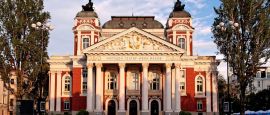
Bulgaria's capital combines Roman remains, Orthodox churches and grand 19th- and 20th-century buildings. The gold-domed Alexander Nevsky Cathedral is the city's best-known landmark, while remains of Roman Serdica can be seen around the city centre. Mount Vitosha rises immediately south of Sofia, providing walking trails and panoramic views.
Bansko
Bansko lies at the foot of the Pirin Mountains and is Bulgaria's best-known ski resort. Its ski area has an extensive network of pistes and lifts, while the surrounding mountains attract hikers outside the winter season. The old town retains stone houses, traditional taverns and the 19th-century Holy Trinity Church.
Belogradchik Rocks and Fortress
The Belogradchik Rocks form a striking landscape of reddish sandstone and limestone formations in northwestern Bulgaria. A historic fortress was built among the rocks, incorporating the natural formations into its defences. Paths and viewpoints around the fortress provide broad views across the surrounding countryside.
Cape Kaliakra
Cape Kaliakra is a narrow headland of reddish cliffs projecting into the Black Sea north of Varna. Archaeological remains on the cape reflect Thracian, Roman, Byzantine and medieval occupation. Walking paths lead past the ruins to viewpoints high above the sea.
Nessebar
Set on a rocky Black Sea peninsula, Nessebar preserves more than 3,000 years of history and is a UNESCO World Heritage Site. Its compact old town contains archaeological remains, medieval churches and traditional timber-framed houses. Narrow cobbled streets make the historic peninsula easy to explore on foot.
Pirin Mountains
The Pirin Mountains are characterised by rugged peaks, glacial lakes and extensive forests. Much of the range lies within UNESCO-listed Pirin National Park, while Vihren, at 2,914m (9,560ft), is Bulgaria's second-highest mountain. Hiking routes range from relatively gentle lake walks to demanding mountain ascents.
Plovdiv
One of Europe's oldest continuously inhabited cities, Plovdiv has traces of Thracian, Roman and Ottoman rule. Its highlights include a remarkably preserved Roman theatre and colourful National Revival houses lining the cobbled old town. Nearby Kapana is a lively quarter of cafés, restaurants, galleries and small shops.
Rhodope Mountains
The Rhodope Mountains spread across southern Bulgaria towards the Greek border, with forested landscapes, caves and traditional villages. The region is strongly associated with Bulgarian folklore and is particularly noted for its distinctive music. Walking routes connect mountain settlements, forests and scenic viewpoints.
Rock-hewn Churches of Ivanovo
Medieval monks carved churches, chapels and cells into cliffs above the Rusenski Lom River near Ruse. The surviving 13th- and 14th-century frescoes are considered outstanding examples of medieval Bulgarian art and have earned the complex UNESCO World Heritage status. The churches lie within the wooded landscape of Rusenski Lom Nature Park.
Rose Valley
The Rose Valley around Kazanlak is the centre of Bulgaria's centuries-old rose-oil industry. Fields of Damask roses bloom from late May into June, when the flowers are traditionally picked early in the morning for distillation. Kazanlak's annual Rose Festival celebrates the harvest with parades, music and traditional events.
Thracian Tomb of Kazanlak
This 4th-century BC tomb is one of Bulgaria's most important Thracian archaeological discoveries and a UNESCO World Heritage Site. Its exceptionally well-preserved frescoes depict a funeral feast, horses and scenes from Thracian life. The original tomb is closed to protect the paintings, but an accurate replica nearby is open to visitors.
Trigrad Gorge
Trigrad Gorge cuts through towering limestone cliffs in the western Rhodope Mountains. A narrow road follows the Trigrad River through the gorge, with rock walls rising steeply on either side. Nearby Devil's Throat Cave contains an underground waterfall and is one of the area's main natural attractions.
Varna
Bulgaria's largest city on the Black Sea combines beaches with museums, archaeological sites and extensive seaside gardens. The Archaeological Museum houses the celebrated Varna Gold, prehistoric objects dating from the fifth millennium BC. The city's Sea Garden stretches along the coast and is a popular area for walking and recreation.
Veliko Tarnovo
Capital of the Second Bulgarian Empire, Veliko Tarnovo occupies a dramatic position on steep hills above the Yantra River. Tsarevets Fortress contains reconstructed walls, towers and the Patriarchal Church. The old quarter has traditional hillside houses, craft workshops and attractive views across the valley.
Do you have any Feedback about this page?
© 2026 Columbus Travel Media Ltd. All rights reserved. No part of this site may be reproduced without our written permission, click here for information on Columbus Content Solutions.



 You know where