
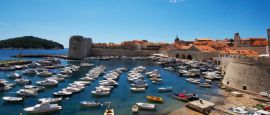


The formidable medieval walls surrounding Dubrovnik's Old City offer stunning views across terracotta rooftops and the Adriatic. Within the walls, the marble-paved Stradun leads past churches, monasteries, fountains and palaces that reflect Gothic, Renaissance and Baroque influences. The UNESCO-listed city also gained international fame as a filming location for King's Landing in Game of Thrones.
Book and Go

Latest features
Croatia things to see and do
Dubrovnik
Hvar
Visit Hvar Town for its Venetian-era architecture, waterfront promenade and hilltop fortress overlooking the harbour and nearby Pakleni Islands. Beyond the town, the island has vineyards, olive groves, lavender fields, secluded coves and historic villages. Near Stari Grad, an agricultural landscape first laid out by Greek colonists in the 4th century BC survives in the UNESCO-listed Stari Grad Plain.
Korčula
The walled old town of Korčula is set on a small peninsula on the island of the same name. Its narrow stone streets were laid out in a distinctive pattern designed to make use of sea breezes while providing shelter from strong winds. The town contains medieval fortifications, Renaissance buildings and the Cathedral of St Mark, while the surrounding island is known for vineyards, olive groves and quiet coves.
Kornati National Park
Sail among the stark limestone islands and clear waters of the Kornati archipelago, one of the most distinctive landscapes on the Croatian Adriatic. The national park encompasses dozens of islands, islets, and reefs, many of which are largely barren and uninhabited. Boat excursions depart from several coastal towns, particularly Murter and settlements around Zadar and Šibenik.
Krka National Park
The Krka River flows through a striking landscape of waterfalls, river valleys and lakes in central Dalmatia. Skradinski buk, a broad series of cascades crossed by walking trails and viewing points, is its best-known attraction. The park also features Visovac Monastery on a small island in the river and archaeological remains associated with the Roman military camp at Burnum.
Mljet National Park
Mljet National Park centres on two saltwater lakes, Veliko Jezero and Malo Jezero, surrounded by pine and Mediterranean woodland. A small island in the larger lake contains a former Benedictine monastery, reached by boat from within the park. Much of the surrounding landscape is densely forested, with walking and cycling trails following the lakes and coastline.
Pag
Pag is a stark, rocky Adriatic island known for traditional lace and distinctive paški sir sheep's-milk cheese. The historic town of Pag has a compact Renaissance centre, while the island's quiet coves, stone walls and grazing sheep reveal a very different side away from its resorts. In summer, Zrće Beach near Novalja becomes one of Croatia's biggest party destinations, attracting visitors from across Europe.
Plitvice Lakes National Park
Follow wooden walkways through Croatia's best-known national park, where a succession of lakes spills over natural barriers in a landscape of waterfalls and dense forest. The lakes are renowned for waters that appear in changing shades of turquoise, green and blue. Plitvice is a UNESCO World Heritage Site and can become extremely busy during the summer months.
Poreč
The Euphrasian Basilica is the centrepiece of Poreč's UNESCO-listed episcopal complex and one of the finest surviving examples of early Byzantine art in the Mediterranean. Its 6th-century apse is decorated with exceptionally well-preserved gold mosaics. The surrounding old town occupies a peninsula whose street plan still reflects its Roman origins.
Pula
Pula has one of Croatia's finest Roman monuments – a remarkably preserved amphitheatre that dominates the city centre. Built during the 1st century AD, the Pula Arena once hosted gladiatorial contests and is still used for concerts and cultural events. Other Roman remains include the Temple of Augustus, the Arch of the Sergii and surviving sections of the city's ancient gateways.
Rovinj
Wander through Rovinj's old town, which rises from a small peninsula above the Istrian coast. Narrow cobbled lanes climb towards the Baroque Church of St Euphemia, whose bell tower dominates the skyline and provides far-reaching coastal views. The harbour, colourful waterfront buildings and surrounding rocky coves make Rovinj a particularly attractive base for exploring western Istria.
Šibenik
The historic centre of Šibenik is a maze of stone lanes and stairways rising from the waterfront. Its outstanding monument is the UNESCO-listed Cathedral of St James, constructed entirely from stone and decorated with a distinctive frieze of sculpted human heads. Above the old town, St Michael's Fortress offers views over the city and the offshore islands.
Split
Split's historic centre, which grew within and around Diocletian's Palace, was built for the Roman emperor around the turn of the 4th century. Ancient gateways, columns, cellars and the former imperial mausoleum are incorporated into a lively maze of streets, cafés, shops and homes. Climb the bell tower of the Cathedral of Saint Domnius for views over the old city and harbour.
Trogir
Explore Trogir's exceptionally well-preserved historic centre, occupying a small island between the mainland and Čiovo. Its street plan dates back to the Hellenistic period, while Romanesque, Gothic, Renaissance and Baroque buildings reflect centuries of subsequent development. The Cathedral of St Lawrence, with its richly carved Romanesque portal, is the architectural highlight of this UNESCO-listed town.
Varaždin
Explore Varaždin, a compact Baroque city in northern Croatia that once served briefly as the country's administrative centre. Pastel-coloured palaces, churches and town houses line its pedestrianised historic streets, while the white-walled Old Town castle now houses the city museum. Varaždin provides a striking architectural contrast to the stone-built towns of the Adriatic coast.
Zadar
Zadar's compact old town is where Roman ruins stand alongside medieval churches and later Venetian architecture. The circular 9th-century Church of St Donatus is one of the city's most recognisable landmarks, while remains of the Roman Forum lie nearby. On the waterfront, the Sea Organ uses the movement of waves to create sounds through pipes built beneath the promenade, beside the light installation Greeting to the Sun.
Zagreb
Zagreb, Croatia's capital, is where the historic Upper Town contrasts with the broad streets, parks and Austro-Hungarian architecture of the Lower Town. St Mark's Church, with its colourful tiled roof, stands near the Croatian Parliament, while the surrounding lanes contain cafés, galleries and museums. The city's extensive café culture, markets and cultural institutions make Zagreb worth more than simply a stop en route to the coast.
Do you have any Feedback about this page?
© 2026 Columbus Travel Media Ltd. All rights reserved. No part of this site may be reproduced without our written permission, click here for information on Columbus Content Solutions.



 You know where