
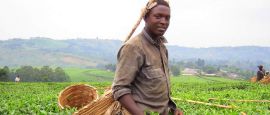

Uganda Weather, climate and geography
Weather & climate
Uganda's equatorial location means it does not have conventional seasons. Instead, the climate is characterised by two dry seasons and two wet seasons, with temperatures remaining relatively consistent throughout the year. Altitude has a more significant effect on temperature than the time of year, with lower-lying areas being warmer and mountainous regions considerably cooler.
Dry seasons (December to February and June to August) are generally considered the best times to visit. Trails in national parks are more accessible, wildlife is easier to spot around water sources, and travel on unpaved roads is more straightforward. These periods are particularly favoured for gorilla trekking in Bwindi and chimpanzee tracking in Kibale.
Wet seasons (March to May and September to November) bring heavier and more sustained rainfall, particularly in the afternoon and evening. The main wet season from March to May can make some roads difficult and trekking conditions more challenging. However, the landscape is lushest during and after the rains, birdwatching is excellent as migratory species are present, and accommodation rates are often lower.
In Kampala and the central plateau, daytime temperatures typically range from 25–29°C (77–84°F) throughout the year. In the western highlands, including the gorilla trekking areas around Bwindi, temperatures are noticeably cooler, often between 11–23°C (52–73°F), and evenings can be cold. The semi-arid Karamoja region in the north-east is the hottest part of the country, with temperatures frequently exceeding 30°C (86°F).
Gorilla trekking is available year-round, though the dry seasons offer easier walking conditions. The best months for Murchison Falls and Queen Elizabeth national parks are during the dry seasons when animal concentrations around water are at their highest.
Lightweight, breathable clothing is suitable for most of Uganda, particularly at lower elevations and in urban areas. Long sleeves and trousers are recommended for protection against mosquitoes and the sun, especially in the evenings and in malaria-risk areas. A hat, sunglasses and sunscreen are advisable.
For gorilla trekking and forest walks, sturdy waterproof hiking boots with good ankle support are essential, along with long trousers, long-sleeved tops and garden-style gloves for gripping vegetation on steep terrain. Lightweight waterproof layers are needed year-round, as rain can fall at any time in the highland forests. Neutral or dark-coloured clothing is recommended for trekking.
At higher altitudes, including the Rwenzori Mountains and around Bwindi, warm layers are important, as temperatures can drop significantly in the evenings and at night. A fleece or warm jacket is advisable for early-morning game drives and highland trekking.
A light rain jacket or compact umbrella is useful throughout the year, as showers can arrive quickly, particularly during the wet seasons.
Geography
Uganda is a landlocked country in East Africa, bordered by Kenya to the east, Tanzania and Rwanda to the south, the Democratic Republic of the Congo to the west and South Sudan to the north. It lies astride the equator, and much of the country consists of a fertile plateau at an average elevation of around 900m above sea level.
The western border is defined by the Albertine Rift, part of the Great Rift Valley, which contains Lakes Albert and Edward and the dramatic Rwenzori mountain range. Mount Margherita, the highest point, rises to 5,109m (16,762 ft). To the east, Mount Elgon, an extinct shield volcano on the Kenyan border, reaches 4,321m (14,177 ft).
Lake Victoria, the world's second-largest freshwater lake by surface area, dominates the southern boundary. The Victoria Nile flows northward from the lake through Lake Kyoga before reaching Murchison Falls and continuing to Lake Albert, from where the Albert Nile flows towards South Sudan. Uganda's abundant water resources and generally well-distributed rainfall support rich vegetation and productive agriculture throughout much of the country.
Do you have any Feedback about this page?
© 2026 Columbus Travel Media Ltd. All rights reserved. No part of this site may be reproduced without our written permission, click here for information on Columbus Content Solutions.



 You know where